The Circle of Neglect (Just Kidding): Why We Love the Skip Hop Activity Center
In the parenting world, there is a pervasive, tongue-in-cheek nickname for the stationary baby saucer: the "Circle of Neglect." We call it this because, for the first time since coming home from the hospital, it allows a parent to do the unthinkable—drink a cup of coffee while it’s actually hot, or perhaps even use the bathroom without an audience.
However, as a pediatric specialist, I view these tools through a different lens. While the humor of "neglect" highlights our desperate need for a hands-free moment, the reality of a high-quality activity center—specifically the Skip Hop Explore & More 3-Stage Activity Center—is that it serves as a "Station of Stimulation." When used correctly and with intentionality, it becomes a vital environment for sensory exploration, motor planning, and cognitive development.
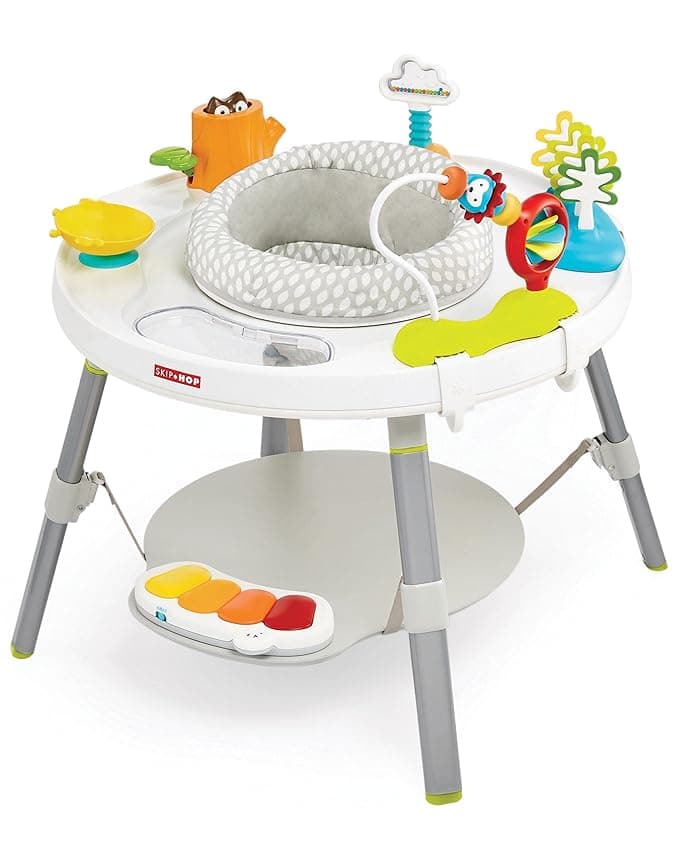
Skip Hop Baby Activity Center: Explore & More
Polyester Grows with Baby in 3 Stages: Our Explore & More Activity Center is designed to support your baby's development in three stages; Sit, Swivel, Bounce & Play; Cruise & Interact; and a smooth play table for toddlers 25+ Developmental Activities: Our activity center includes a musical, light-up piano with three modes (piano, song, and motion sensor), a peek-a-boo owl that pops out and hoots and clip-on toys that can be positioned based on your baby's abilities Versatile Use: Suitable for ages 4 months and up, our activity gym supports up to 25 lbs (11.3 kg), ensuring long-lasting use as your little one grows Unique Discovery Window: The Discovery Window allows your baby to see their feet and the piano while playing, helping them understand cause and effect while enhancing sensory development and hand-eye coordination Practical Maintenance: The activity center includes a machine-washable polyester seat and a dishwasher-safe suction bee snack bowl for easy cleanup. The tool-free assembly allows quick setup, and the detachable legs make storage simple and space-efficient Adjustable Design: The 360-degree rotating seat turns for bouncing and includes toy loops to attach toys. The foot support platform adjusts to the perfect height for your baby. Coordinates with the Skip Hop Explore & More collection
The Science of Play: Why Activity Centers Matter
Before diving into the specifics of the Skip Hop model, it is important to understand what is happening in a child’s brain and body during the first year of life. Infants are in a period of rapid neurological blooming. Every sensation—the texture of a toy, the sound of a squeaker, the visual feedback of their own movement—strengthens synaptic connections.
From a physiological perspective, an activity center provides:
- Proprioceptive Input: This is the body’s ability to sense its location, movements, and actions. When a baby bounces or shifts their weight in the seat, they are receiving feedback through their joints and muscles.
- Vestibular Development: As the seat swivels 360 degrees, the inner ear sends signals to the brain about balance and spatial orientation.
- Visual-Motor Integration: Coordinating what the eyes see with what the hands do.
A Longitudinal Investment: The 3 Stages of Growth
One of the primary critiques of the "baby gear industry" is the planned obsolescence of products. Most items are designed for a three-month window of development. The Skip Hop Activity Center disrupts this cycle by offering a three-stage evolution that follows the child from four months to the preschool years.
Stage 1: Sit, Swivel, and Bounce
Designed for infants who have achieved steady head control (typically around 4 months), this stage focuses on core stability and multi-sensory engagement. The seat is made of a breathable, machine-washable fabric that supports the infant while allowing their legs to dangle onto a height-adjustable foot platform.
Expert Pediatric Tip: Ensure the platform is adjusted so the baby’s feet are flat. We want to avoid "toe-pointing," as prolonged weight-bearing on the toes can lead to tight Achilles tendons and potential gait issues later on.
Stage 2: The Cruising Phase
As your child approaches the 9- to 12-month mark, their needs shift from "contained play" to "exploratory play." In this stage, the seat is removed, and the center transforms into a sturdy table surrounded by toys. This encourages "cruising"—the act of walking while holding onto furniture. Cruising is a critical precursor to independent walking as it builds lateral hip strength and teaches the child how to shift their center of gravity safely.
Stage 3: The Toddler Table
By age two, most activity centers are relegated to the garage or a donation bin. However, the Skip Hop model includes a plastic cover that converts the unit into a sleek, sturdy toddler table. Whether it is for coloring, puzzle-building, or a quick snack, this stage honors the child’s growing independence and provides them with a dedicated workspace.
The Discovery Window: A Lesson in Cause-and-Effect
If you ask a developmental psychologist what the most important feature of the Skip Hop Activity Center is, they won't point to the toys on top. They will point to the "Discovery Window."
This clear window at the base allows the baby to look down and see their own feet while they play with the light-up piano. In many traditional saucers, the baby’s lower extremities are hidden by a plastic tray. By allowing the infant to see the physical source of the music (their feet hitting the keys), the Skip Hop center facilitates a higher level of cognitive mapping. They aren't just hearing a sound; they are witnessing the physical mechanics of cause-and-effect. This builds the foundation for "means-end" thinking, a crucial milestone in early childhood cognitive development.
Aesthetics and the "Modern Home" Reality
We must address the "plastic explosion" phenomenon. Many parents find their living rooms slowly transformed into a kaleidoscope of primary colors and loud electronic noises. While children are attracted to bright colors, an over-stimulated environment can lead to sensory overload for both the child and the parent.
The Skip Hop Explore & More utilizes a sophisticated color palette—muted grays, soft whites, and intentional pops of color. It is designed to be high-functioning without being an eyesore. In a world where our homes have become multi-functional spaces (offices, gyms, and nurseries), having gear that complements a modern aesthetic is not just a "luxury"—it’s a contribution to a calmer, more organized household environment.
Expert Guidelines for Safe and Effective Use
While we love the Skip Hop for its developmental benefits, "The Circle of Neglect" nickname carries a kernel of truth that parents should heed: these tools should be used in moderation.
The 20-Minute Rule
As a pediatric specialist, I recommend the "20-minute rule." Limit your child’s time in a stationary seated position to 20 minutes at a time, a few times a day. This prevents "Container Syndrome," a term used to describe developmental delays or physical issues (like flat-head syndrome or hip dysplasia) that can occur when infants spend too much time in car seats, swings, and saucers.
Parent-to-Parent Tip: Toy Rotation
The toys on the Skip Hop center are clip-on and movable. To keep your child engaged, don’t put all the toys on at once. Rotate them every few days. This keeps the "novelty factor" high and encourages the child to reach in different directions, crossing the midline of their body—a movement that is essential for bilateral coordination.
When to Call the Doctor: Developmental Red Flags
While every child develops at their own pace, there are certain milestones to watch for while your child is using an activity center:
- Head Lag: If your child is 4 months or older and cannot hold their head steady while in the seat, consult your pediatrician to check for neck strength or torticollis.
- Asymmetry: If your child only reaches with one hand or only swivels the seat in one direction, mention this at your next well-baby visit.
- Lack of Engagement: If a child does not show interest in the toys or the light-up features by 6 months, it may be worth discussing sensory or visual processing with a specialist.
Why Quality Matters in Baby Gear
In an era of "fast furniture" and cheap imports, investing in a high-quality product is a matter of safety and sustainability. The Skip Hop Activity Center is BPA-free, PVC-free, and Phthalate-free. It undergoes rigorous testing to ensure that it won't tip over and that small parts won't become choking hazards.
When we choose quality over quantity, we aren't just buying a toy; we are buying peace of mind. We are choosing a product that will withstand the rigorous "testing" of a toddler (which usually involves a lot of banging and chewing) and still be functional enough to pass down to a sibling or a friend.
The Verdict
The Skip Hop Explore & More 3-Stage Activity Center is a rare bridge between parental convenience and pediatric health. It respects the child's need for exploration and the parent's need for a safe, contained space. While we might joke about "neglecting" our duties for a few minutes while the baby is happily swiveling and kicking the piano, the truth is that we are providing them with a rich, multi-sensory laboratory.
If you are looking for one substantial piece of gear that earns its footprint in your home, this is it. It is a thoughtful, evidence-based tool that supports your child from their first shaky "sit-up" to their first masterpiece drawn at their very own toddler table.