The Ultimate Guide to Cognitive Development in the First Year
The first year of your baby's life is a magnificent journey, not just of physical transformations like those adorable chubby rolls, the emergence of the first tooth, or the thrilling discovery of rolling over. Beneath these visible markers, an even more profound and spectacular metamorphosis is unfolding: the rapid, explosive development of their brain. This foundational period, marked by incredible neuroplasticity, lays the groundwork for all future learning, emotional regulation, and social interaction.
Cognitive development refers to the intricate processes through which your baby learns, thinks, remembers, and problem-solves. It encompasses the burgeoning of memory, the acquisition of language, the ability to sustain attention, and the early stages of reasoning. In just 12 short months, your seemingly helpless newborn evolves into a curious, interactive toddler who grasps cause and effect, recognizes familiar faces, understands a growing lexicon, and may even be uttering their first intentional words. This remarkable journey is powered by billions of new neural connections forming and strengthening every single day.
This guide explores the major cognitive milestones of the first year, offering science-backed insights into why these changes occur and providing practical, parent-approved activities you can do to lovingly nurture your baby's budding brilliance.
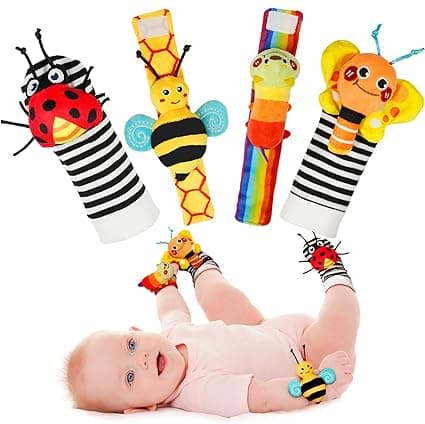
Infinno Baby Wrist Rattle Socks and Foot Finder Set, Perfect Baby Toys for 0-12 Months Newborn Boys and Girls As Shower Gifts, Garden Bug Series
PROMOTE SENSORY EXPLORATION - The bright colorful rattle socks will promote baby sensory exploration through sight, touch and sound. Baby boys and girls will be encouraged to grab and reach the bright colorful wrist rattles and foot finders.
Providing high-quality, age-appropriate products, like stimulating rattles and soft sensory toys, plays an important role in supporting cognitive development. These tools offer safe, engaging ways for babies to explore, learn, and interact with their environment, complementing the invaluable interactions they have with their caregivers.
The Newborn Phase (0-2 Months): The Awakening of Senses
In these earliest weeks, your baby's brain is primarily focused on survival and processing the overwhelming influx of sensory information from their new world. The brainstem, responsible for vital functions, is highly active, while the limbic system begins to regulate early emotions and drive attachment. Though their vision is blurry, particularly for distant objects, their hearing is remarkably acute, and their sense of touch is well-developed. This phase is crucial for establishing trust and forming the secure attachments that are vital for healthy brain development.
Key Milestones
- Face Recognition: From birth, babies exhibit an innate preference for looking at human faces over inanimate objects. This is not arbitrary; specialized areas in the brain, like the fusiform face area, begin early processing, recognizing the importance of faces for social connection. By 6-8 weeks, this preference often culminates in their first genuine social smile—a profound cognitive leap signaling recognition of you and a positive, reciprocal connection. This smile is a powerful feedback loop, strengthening neural pathways for social engagement.
- Sensory Processing: Newborns begin to track moving objects with their eyes, though often with jerky movements (saccades) rather than smooth pursuit. They also instinctively turn their heads toward sounds (auditory localization), demonstrating their brain's ability to map sound sources in space. These actions are early signs of sensory integration and developing spatial awareness.
- Crying as Communication: Your baby quickly learns that crying brings a response—food, comfort, a diaper change. This is a fundamental lesson in cause and effect and the very first form of communication and agency. It's a primal form of operant conditioning, reinforcing that their actions can influence their environment.
How to Support Development
- Talk and Sing: Your voice is their favorite sound, and "parentese" (infant-directed speech—higher pitch, slower tempo, exaggerated intonation) is their favorite language. Narrate your day ("Now we're changing your diaper," "Let's go for a walk") to lay the foundational neural pathways for language acquisition. This consistent auditory input helps them distinguish sounds and recognize patterns in speech.
- High-Contrast Play: Because their cones (color receptors) are still immature and their optic nerves are developing, high-contrast images (black-and-white patterns, bold shapes) are easier for their developing visual cortex to process. This stimulates visual pathways, encourages longer gaze times, and helps build attention span. Hold objects 8-12 inches from their face, as this is their optimal focal range.
- Skin-to-Skin Contact (Kangaroo Care): Touch is not just comforting; it's critical for brain development. Skin-to-skin contact reduces stress hormones (cortisol), promotes the release of oxytocin (the "love hormone"), and helps regulate heart rate, breathing, and body temperature. These physiological benefits promote robust neural connections in areas related to emotional regulation and stress response.
- Parent-to-Parent Tip: Embrace the "fourth trimester." Your primary role is to provide a safe, loving, and predictable environment. Responding consistently to your newborn's cues helps build a secure attachment, which is the bedrock for all future cognitive and emotional development. Don't worry about "spoiling" a newborn; you're simply building trust.
The Explorer Phase (3-5 Months): Curiosity Ignites
As their vision sharpens, neck muscles strengthen, and purposeful movements emerge, babies begin to engage more actively and intentionally with their world. This is the era of "reaching out"—both physically and metaphorically—as their cognitive horizons expand. The parietal lobe, crucial for spatial awareness and sensory integration, becomes increasingly active.
Key Milestones
- Cause and Effect Basics: Babies discover their own hands and feet, often staring intently at them. This self-discovery is a crucial cognitive step, as they realize, "I control that!" They wave their arms, see their hands move, and begin to understand their own agency in the world. This is an early form of intentional action, laying the groundwork for more complex problem-solving.
- Object Tracking: Their smooth pursuit eye movements become much more refined. They can now smoothly follow a moving object from side to side, up and down, and even in circles. This indicates improved coordination between their visual cortex and oculomotor control centers.
- Reach and Grasp: Hand-eye coordination improves dramatically. Babies start batting at and reaching for toys, though their initial attempts might be clumsy. This "swatting" and eventually grasping helps them learn about distance, depth, and the properties of objects. The motor cortex is rapidly developing connections for these voluntary movements.
- Memory Building: They begin to recognize familiar people and objects from a distance, and may even show excitement at the sight of a favorite toy or caregiver entering the room. This signifies the early development of working memory and the ability to form mental representations of familiar stimuli.
How to Support Development
- Mirror Play: Babies are fascinated by reflections. Offering a baby-safe mirror boosts visual attention, encourages social curiosity (they often treat their reflection as another baby), and begins to foster a nascent sense of self-awareness. Discussing what they see helps reinforce language.
- Texture Exploration: Provide a variety of safe toys with different textures—crinkly, soft, bumpy, smooth. This rich sensory input helps build neural pathways in the somatosensory cortex related to touch discrimination and sensory integration, crucial for understanding the physical world.
- Tummy Time: While essential for physical strength (preventing flat spots, developing neck and core muscles), tummy time is also a powerful cognitive stimulator. From this new vantage point, they see the world differently, encouraging visual exploration, depth perception, and spatial reasoning as they lift their heads and pivot.
- Expert Tip: Ensure a safe environment for exploration. As reaching and grasping skills develop, babies will put everything in their mouths. Child-proofing becomes paramount during this phase to prevent choking hazards and exposure to toxins.
The Scientist Phase (6-8 Months): Investigation and Object Permanence
This period is a golden age of cognitive leaps, where your baby truly becomes a little scientist. They are actively conducting experiments on gravity (dropping the spoon from the high chair), acoustics (banging toys together), and social dynamics (laughing when you laugh, seeing if you'll respond to their babbles). The prefrontal cortex begins to show more activity, supporting goal-directed behavior.
Key Milestones
- Object Permanence: A groundbreaking cognitive achievement, typically emerging around 6-9 months. Babies begin to understand that objects continue to exist even when they can't see them. This is why peek-a-boo becomes so utterly delightful—it tests and confirms this hypothesis, as they learn that "you" still exist even when hidden. This ability to form mental representations of absent objects is fundamental to memory and abstract thought.
- Imitation: Babies start to actively copy sounds, facial expressions, and simple gestures. This imitation is a sign of social learning, empathy development, and the activation of "mirror neurons" in the brain that help them understand and anticipate others' actions.
- Babbling: The emergence of reduplicative babbling ("ba-ba," "ma-ma," "da-da") is a major language milestone. They are practicing the mechanics of speech, experimenting with vocal cords, and refining their ability to produce specific phonemes (speech sounds). This is a crucial precursor to spoken language.
- Depth Perception: By this age, babies have developed significant depth perception. Classic "visual cliff" experiments demonstrate that they understand that an apparent drop-off is dangerous, indicating mature visual processing and spatial awareness.
How to Support Development
- Peek-a-Boo and Hiding Games: These classic games are more than just fun; they are powerful tools for reinforcing object permanence. Hide a favorite toy under a blanket while they watch, and encourage them to find it. Gradually make the hiding more complex to challenge their emerging understanding.
- "Conversation": Respond to their babbles as if they are words, engaging in "serve and return" interactions. This back-and-forth teaches the rhythm and turn-taking of conversation, stimulates language pathways, and strengthens their motivation to communicate. Make eye contact and genuinely listen to their sounds.
- Cause and Effect Toys: Simple pop-up toys, busy boards with buttons and levers, or stacking cups are fantastic for this age. They allow babies to experiment with actions and predictable outcomes, fostering problem-solving skills and an understanding of how things work.
- Parent-to-Parent Tip: Encourage independent play with safe, stimulating toys. Give them space to explore and experiment on their own while remaining present and available for interaction. This fosters autonomy and problem-solving.
The Solving Phase (9-12 Months): Intentionality and Recall
As you approach the first birthday, your baby isn't just reacting to the world; they are increasingly planning and acting with intention. Their frontal lobes are rapidly developing, supporting executive functions like planning and impulse control. They begin to set goals (e.g., get the cookie) and figure out the steps to achieve them (e.g., pull up on the chair, reach for the counter).
Key Milestones
- Problem Solving: Babies demonstrate more sophisticated problem-solving skills. They might pull a string to bring a desired toy closer, remove a lid to get something inside, or manipulate objects to fit them together. This shows emerging means-end reasoning and flexible thinking.
- Functional Play: They start using objects correctly in play—putting a toy phone to their ear, pretending to brush their hair, or pushing a toy car. This signifies early symbolic thought and an understanding of the purpose of objects in their world.
- Receptive Language: While their expressive language (what they say) may still be limited, their receptive language (what they understand) expands rapidly. They know their name, "no," simple commands like "wave bye-bye," and may point to familiar objects when asked. This "vocabulary spurt" often precedes a speaking spurt.
- Separation Anxiety: While often emotionally challenging for parents, separation anxiety is a significant cognitive and emotional milestone. It signifies that your baby has a strong memory of you, understands you are a separate individual, and has formed a secure attachment, understanding that you can leave and return.
How to Support Development
- Naming Everything: Continuously narrate and label the world around them. "This is a red ball." "Look at the big, fluffy dog." "Daddy is eating an apple." This constant labeling builds their receptive and expressive vocabulary rapidly, linking words to concepts and objects.
- Filling and Dumping: Simple activities like giving them a bucket and blocks to put in and take out are incredibly beneficial. This seemingly simple action helps them understand volume, containment, gravity, and cause and effect, while also refining fine motor skills.
- Reading Together: Make reading a cherished daily ritual. Board books with simple stories, bright illustrations, and interactive elements (lift-the-flaps, textures) are perfect. Let them "help" turn the pages, point to pictures, and engage with the story. This fosters language acquisition, concentration, and a love for books.
- Expert Tip: Encourage independence within safe boundaries. Allow your baby to explore, make choices (within reason), and solve simple problems on their own. This builds confidence and autonomy. For example, let them try to retrieve a toy slightly out of reach rather than immediately handing it to them.
Red Flags: When to Consult a Pediatrician
Every baby develops at their own unique pace, and the range of "normal" is wonderfully wide. However, trust your instincts as a parent. Early intervention can make a significant difference if there are developmental concerns. Consult your pediatrician if your baby:
- By 3 Months:
- Doesn't seem to watch things as they move or doesn't follow moving objects with their eyes.
- Doesn't smile at people or show interest in faces.
- Doesn't respond to loud sounds.
- Doesn't bring hands to mouth.
- By 7 Months:
- Doesn't try to get objects that are out of reach.
- Doesn't show affection for caregivers (e.g., cuddle, smile back).
- Doesn't react to familiar faces or recognize parents.
- Doesn't respond to sounds or their own name.
- Has very stiff or floppy muscle tone.
- By 12 Months:
- Doesn't babble or make a variety of sounds.
- Doesn't gesture (e.g., wave bye-bye, shake head "no").
- Doesn't seem to look for things when they see them hidden.
- Doesn't point to objects or pictures.
- Doesn't respond to their name consistently.
- Doesn't understand simple commands.
- Doesn't try to imitate sounds or actions.
- Doesn't crawl or has very uneven movements.
- At Any Age:
- Loses skills they once had (e.g., stops babbling, stops making eye contact). This is a particularly important red flag and warrants immediate medical attention.
- Has difficulty feeding or swallowing.
- Doesn't make eye contact.
- Seems overly sensitive or unresponsive to sensory input (e.g., sounds, touch).
Always discuss any concerns with your child's pediatrician. They are your best resource for guidance and can refer you to specialists if needed.
Conclusion
The first year of life is a marathon of mental growth, a period of unprecedented neurological formation and refinement. By understanding these fascinating cognitive milestones, you can move from merely worrying about whether your baby is "on track" to truly marveling at the complex, beautiful work their little brains are doing every single day.
Remember, the most powerful educational tool for your baby isn't a high-tech tablet, an expensive gadget, or a structured curriculum—it's you. Your consistent love, focused attention, responsive interaction, and active engagement are the most potent fuels that power this incredible journey of cognitive development. Embrace the wonder, talk, sing, read, and play. Your presence is the greatest gift you can give their developing mind.