Language Explosion: Encouraging Speech from Birth to 2 Years
The journey from a newborn’s first reflexive cry to a toddler’s defiant and triumphant "I do it myself!" is one of the most complex cognitive feats a human ever performs. In just 24 months, a child’s brain undergoes a massive structural transformation, building millions of neural connections every second. This "Language Explosion" is not just about learning labels for things; it is the process of a human being learning how to connect their inner world to the outer world.
As parents, it is easy to focus solely on that first "Mama" or "Dada," but speech is only the tip of the iceberg. To truly support your child, we must look at the two distinct pillars of communication:
- Receptive Language: This is the "input." It refers to how your child understands and processes what is said to them. Long before they can say "shoes," they can follow a command like "Go get your shoes."
- Expressive Language: This is the "output." It involves using gestures, sounds, and eventually words to communicate needs, feelings, and ideas.
At GooGaia, we believe that the environment you curate—including the toys they grasp and the books you share—acts as the scaffolding for this development. Using high-quality, open-ended tools allows children to focus on the interaction rather than the distraction of flashing lights or loud electronic noises.
Phase 1: The Sponge (0–6 Months)
During the first six months, your baby is a linguistic scientist. They are busy categorizing every phoneme (individual sound) of the language spoken in their home. Research shows that by six months, babies can already distinguish between the subtle sounds of their native tongue and foreign languages.
The Power of "Parentese"
You might feel silly using that high-pitched, elongated, sing-song voice, but it is a biological tool. Known scientifically as Infant-Directed Speech, Parentese helps babies map language. The exaggerated vowels and slow pace make it easier for their developing brains to segment where one word ends and the next begins.
Auditory Bombardment through Narration
Think of yourself as a live sportscaster for your baby’s life. This technique, called "narration," provides a constant stream of meaningful data.
- The "Why": When you say, "I am picking up the soft, blue towel now," you are connecting a physical sensation with a specific vocabulary word.
- Expert Tip: Don't just narrate your actions; narrate their feelings. "You are kicking your legs! You look so excited for your bath." This builds the foundation for emotional intelligence.
Early Literacy Foundations
It is never too early to read. At this stage, reading isn't about the plot; it’s about the rhythm of language and the "print awareness"—learning that we turn pages from right to left and that pictures represent real-world objects.
Phase 2: The Babbler (6–12 Months)
Around the half-year mark, the "cooing" of early infancy transforms into something more rhythmic. This is the stage of motor practice; your baby is learning how to coordinate their lips, tongue, and vocal cords.
Canonical Babbling
When your baby starts saying "Ba-ba-ba" or "Da-da-da," they are engaging in canonical babbling. This is a major developmental milestone.
- Parent-to-Parent Tip: Treat these babbles like a real conversation. If they say "Ba-ba!", respond with, "Oh, really? Tell me more!" This teaches the "serve and return" nature of human communication.
The Bridge: Gestures and Joint Attention
Before a child has the fine motor control to speak, they use their whole body. Pointing is perhaps the most significant predictor of future language success. When a child points at a dog and looks at you, they are engaging in "Joint Attention." They are saying, "I see that, and I want you to see it too."
Introducing Baby Sign Language
Many parents worry that signing will delay speech. In reality, the opposite is true. Signs reduce frustration by giving the child a way to communicate before their vocal tract is ready.
- Start with the "Big Four": Milk, More, All Done, and Help.
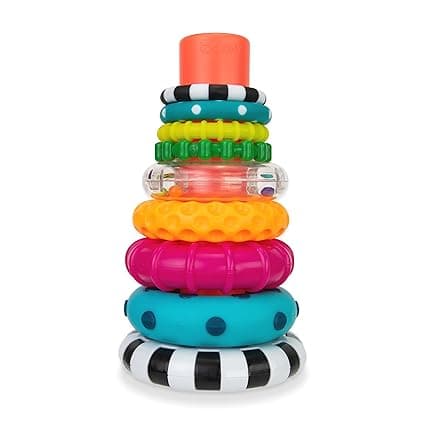
- Product Context: Use high-quality, tactile toys to reinforce these signs. While playing with a stacker, use the sign for "More" before giving them the next ring.
Phase 3: The First Words (12–18 Months)
The transition from babbling to "true words" is a graduation. But what actually qualifies as a word? As a specialist, I look for three specific criteria:
- Consistency: They use the same sound for the same object every time.
- Intent: They are purposefully trying to communicate.
- Independence: They say it on their own, not just repeating you.
The "Animal Sound" Rule: If your child sees a cat and says "Meow," that counts as a word! If they see a car and say "Vroom," that counts too. These are symbolic representations, which is the core of language.
Scientific Context: The Vocabulary Threshold
By 18 months, most children have a "lexicon" of 20 to 50 words. However, their receptive vocabulary is likely ten times that size. They understand almost everything you say, even if they can't say it back yet.
Phase 4: The Explosion (18–24 Months)
This is the "Language Explosion" proper. Once a child hits the 50-word mark, their brain often begins to "fast-map" new words, sometimes picking up several new words a day.
The Birth of Grammar
Between 18 and 24 months, children begin combining words into two-word telegraphic phrases: "Mommy up," "More juice," or "Doggy go." This is the beginning of syntax and grammar. They are no longer just labeling the world; they are describing actions and relationships.
Intelligibility Milestones
By age two, a general rule of thumb is that a stranger should be able to understand about 50% of what your child says. You, as the parent, will understand much more because you "speak toddler," but the clarity of their speech sounds (articulation) should be improving steadily.
Top Strategies to Boost Speech at Home
1. The 10-Second Rule (Wait for it!)
In our fast-paced world, we often finish our children’s sentences or anticipate their needs before they ask.
- The Strategy: Ask a question (e.g., "Do you want the apple or the banana?") and then slowly count to ten in your head.
- The Why: A toddler’s brain needs significantly more time to process the linguistic input, decide on an answer, and coordinate the motor movements to speak. Giving them space prevents "communication laziness."
2. The "+1 Expansion" Rule
Always stay one step ahead of your child’s current level.
- If they say "Truck," you say "Big truck."
- If they say "Big truck," you say "Big red truck."
- If they say "Big red truck," you say "The big red truck is fast!" This provides them with a natural model for the next stage of their development without making them feel corrected.
3. Get Face-to-Face
Physical positioning matters. Get down on the floor. When you are at eye level, your child can watch the shape of your mouth and the movement of your lips. This visual information is crucial for learning how to produce difficult sounds like f, p, b, and m.
4. Meaningful Repetition
Children thrive on predictability. Reading the same book 100 times might be tedious for you, but for a toddler, it is a masterclass in language. Each repetition strengthens the neural pathways associated with those specific words and sentence structures.
The Digital Dilemma: Screen Time and Speech
Current research from the American Academy of Pediatrics is clear: passive screen time (watching a show alone) provides almost zero linguistic benefit for children under two.
Language is a social act. Humans possess "social gating," meaning our brains prioritize learning from live, interactive humans over 2D images.
- Expert Tip: If you do choose to use screens (like video chatting with a grandparent), make it interactive. Talk about what is happening. Use the screen as a talking point, not a babysitter.
When to Seek Help: The "Wait and See" Myth
As a pediatric specialist, I always tell parents: Trust your gut. Early intervention is one of the most effective tools we have. It is much easier to bridge a small gap at 18 months than a large gap at 4 years.
Consult a Speech-Language Pathologist (SLP) or your pediatrician if you notice:
- 9 Months: No babbling or back-and-forth "vocal play."
- 12 Months: No pointing or waving; no response to their name.
- 15 Months: No "true" words or limited understanding of simple commands.
- 18 Months: Fewer than 10-15 words.
- 24 Months: Fewer than 50 words; not combining two words together; or if you are concerned that they aren't hearing well.
Conclusion
Your child’s journey toward language is a marathon, not a sprint. Every time you describe the texture of a toy, sing a song in the car, or wait those extra ten seconds for them to respond, you are building the architecture of their mind. You are their first, most important, and most influential teacher. Surround them with words, high-quality play, and lots of patience—the explosion is coming!