Is the Lovevery Play Gym Worth $140?
As a pediatric specialist and a parent, I have spent countless hours observing how infants interact with their environment. In those first twelve months, a baby’s brain is a sponge, forming over one million new neural connections every single second. While the market is flooded with flashing lights and battery-operated gadgets promising to "genius-ify" your infant, the reality is that developmental growth thrives on simplicity, intentionality, and sensory-rich experiences.
The Lovevery Play Gym has become a staple of the modern nursery, often seen as a status symbol on social media. However, at $140, parents naturally ask: Is this a justified investment in my child’s development, or am I just paying for an aesthetic?
Below, we dive into the developmental science, the practical design, and the long-term value of this play gym to help you decide if it’s the right fit for your home.
The Science of Play: Why the First Year Matters
To understand the value of a high-quality play gym, we must first look at the neurological milestones of the first year. Infants move through distinct phases of development: from the initial "visual fog" of the newborn days to the refined motor skills required to grasp a specific object, and eventually, the cognitive leap of understanding object permanence.
The Lovevery Play Gym was designed by child development experts—including neuroscientists and occupational therapists—to align with these specific windows of opportunity. Unlike generic mats, which often provide a "sensory soup" of confusing stimuli, this gym focuses on "scaffolded learning." This means providing the right challenge at the right time. When a child is given tools that match their current developmental stage, they experience a sense of mastery that builds confidence and focus.
A Closer Look at the Five Sensory Zones
The standout feature of the Lovevery Play Gym is its "Zone" system. The mat is divided into five distinct areas, each targeting a specific developmental pillar. Crucially, these zones can be folded up and hidden, allowing you to reveal only what your baby is ready for.
1. Learning to Focus
In the first few months, an infant’s vision is limited. They see best in high-contrast (black and white) and can only focus on objects about 8 to 12 inches away. This zone provides high-contrast imagery that helps strengthen the ocular muscles and promotes visual tracking—a precursor to reading and hand-eye coordination.
2. Making Sounds
This zone introduces the concept of cause and effect. By kicking or batting at elements that crinkle or squeak, your baby learns that their physical movements have an external result. From a pediatric perspective, this is a vital cognitive milestone that bridges the gap between involuntary reflex and intentional action.
3. How Things Feel
Tactile exploration is how babies map their world. This zone features different textures—silky, fuzzy, ribbed—that stimulate the somatosensory cortex. Exposure to varied textures early on can help prevent sensory processing sensitivities later in life.
4. Hiding and Finding
As your baby approaches the 6-to-9-month mark, they begin to understand object permanence—the idea that something still exists even if they can’t see it. This zone features a "peek-a-boo" flap that encourages this cognitive leap, which is also a major milestone in reducing separation anxiety.
5. Colors and Naming
As color vision matures, this zone provides a palette for visual discrimination. It’s an excellent space for "language nutrition"—the practice of parents narrating what the baby is seeing to build their future vocabulary.
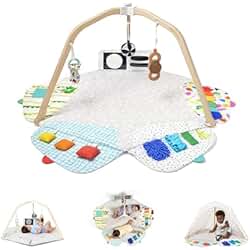
The Play Gym by Lovevery
FROM TUMMYTIME TO PLAYFORT: Lovevery knows nothing is more important than your baby's physical, cognitive, visual and motor learning; from lifting their head as a newborn to hide-and-seek as a toddler, The Play Gym provides a whole year of play
The Problem with Overstimulation
As an expert, one of my primary critiques of modern baby toys is the "overstimulation factor." Many play gyms feature battery-powered lights, loud electronic music, and jarring primary colors scattered everywhere.
When a baby is bombarded with too much stimuli, their nervous system can become overwhelmed, leading to irritability, poor sleep, and a "shut down" response. The Lovevery Play Gym counters this by using a neutral, calming base and the ability to "close" zones that are not in use. By limiting the options to one or two focused activities, the gym encourages deep concentration and longer periods of independent play. This "quality over quantity" approach is a core tenet of the Montessori philosophy, which emphasizes a prepared environment that fosters independence.
From Tummy Time to Toddler Forts: Longevity and Value
One of the most common reasons parents regret baby purchases is the "obsolescence curve." Many toys are only useful for a 2-to-3-month window. The Lovevery Play Gym, however, is designed to grow with the child for a full 12 months and beyond.
- 0–4 Months: Focuses on back play, visual tracking, and the beginning of tummy time.
- 5–8 Months: Focuses on rolling, grasping, and sitting up to explore the textures.
- 9–12 Months: The gym includes a "Play Space Cover" that transforms the wooden frame into a cozy tent or fort.
This transformation into a "cozy corner" extends the life of the product well into the toddler years. In a world where we are increasingly conscious of environmental impact and household clutter, choosing one high-quality, multifunctional item over ten cheap plastic toys is both an ecological and a practical win.
Parent-to-Parent: Tips for Maximizing the Play Gym
If you decide to invest in the Lovevery Play Gym, here are a few tips to ensure you get the most out of it:
- Rotate the Toys: The gym comes with several hanging accessories (a wooden batting ring, a cotton organic ball, and a silicone gripper). Don't hang them all at once. Swap them out every few days to keep your baby's interest high without overwhelming them.
- Use the Play Guide: The gym comes with a research-backed guide. Don't toss it! It contains specific activities and "play prompts" for every month of age that are incredibly helpful for tired parents who might not know how to engage with a newborn.
- Tummy Time Success: If your baby dislikes tummy time (as many do), use the "Learning to Focus" zone. Prop the high-contrast cards up in the card holder at their eye level. This visual "reward" can often encourage babies to hold their heads up longer.
- Keep it Clean: The mat is machine washable. However, to maintain the integrity of the hidden zones, I recommend washing on a cold, gentle cycle and air-drying.
Expert Tip: When to Monitor Development
While the Lovevery Play Gym is an excellent tool for supporting milestones, it is also a great "observation deck" for parents. When your baby is playing, keep an eye on these developmental markers:
- By 3 Months: Is your baby starting to follow moving objects with their eyes? Are they beginning to push up during tummy time?
- By 6 Months: Are they reaching for toys with both hands? Are they starting to roll in both directions?
- By 9 Months: Are they sitting without support and transferring objects from one hand to the other?
When to Call the Doctor: If you notice your baby consistently favors one side of their body, seems excessively floppy or stiff, or does not react to the sounds (the crinkle/squeak zone) or visual stimuli by 4 months, mention it to your pediatrician. Early intervention is the key to resolving many minor developmental delays.
The Verdict: Quality Over Quantity
So, is it worth $140?
From a pediatric and developmental standpoint, the answer is yes.
While the price tag is higher than a standard plastic gym from a big-box store, you are not just buying a mat; you are buying a curated developmental program. By eliminating the need for a separate tummy time mat, a sensory bin, a set of high-contrast cards, and various teething toys, the Lovevery Play Gym actually saves money and space in the long run.
The construction is robust—using FSC-certified wood, organic cotton, and BPA-free silicone—which means it will likely survive for a second or third child, further increasing its value. In the world of parenting, where "more" is often marketed as "better," this play gym stands as a testament to the fact that a thoughtful, expert-designed environment is the best gift you can give your developing child.