The Power of Play: Age-Appropriate Toys for the First Year
Walk into any toy store and you are assaulted by flashing lights, singing crabs, and plastic everything. But the best toy for a baby is usually... a cardboard box. Or your face.
Play is not just "fun." Play is the work of childhood. It is how they learn physics (gravity!), biology (my hand moves!), and sociology (mom smiles when I do this!).
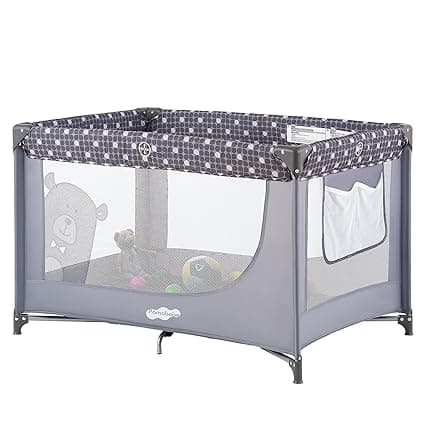
Pamo Babe Compact Pack and Play - Portable Crib for Baby, Lightweight Foldable Travel Playard with Mattress Pad & Carry Bag, Safe Breathable Travel Bed for Home, Trips & Family Visits, Cute Pattern
[Easy Assembly & Compact Folding] No tools required for assembly or folding. Takes up minimal space when folded (26.18"* 7.48"*7.48"). Weighing just 17.6 lbs., you can hold it with just one hand.
0-3 Months: The Observer
They can't hold much yet. They are absorbing visual information.
- Best Toy: High Contrast Cards (Black & White). Their retina is not fully developed, so high contrast images stand out and build optic nerve connections.
- Best Toy: A Floor Mirror. They love faces. Even their own (though they don't know it's them yet).
- Best Toy: A simple Rattle. They will accidentally hit it and learn cause-and-effect.
3-6 Months: The Grabber
Hand-eye coordination is booting up. They want to put everything in their mouth.
- Best Toy: Oball. The holes make it easy for clumsy fingers to grip.
- Best Toy: Crinkle Paper/Books. The sound is rewarding without being overstimulating.
- Best Toy: Teethers. Different textures (nubby, smooth, cold) help map the mouth.
6-9 Months: The Investigator
Sitting up changes everything. They can manipulate objects with two hands.
- Best Toy: Stacking Cups. They won't stack them yet. They will knock them down and bang them together.
- Best Toy: A Basket of "Stuff" (Treasure Basket). Put safe household items in a low basket: A wooden spoon, a clean whisk, a piece of silk, a pinecone.
- Best Toy: Board Books with textures (Touch and Feel).
9-12 Months: The Mover & Shaker
They are mobile and working on fine motor skills (pincer grasp).
- Best Toy: Push Walker. (Not a sit-in walker, which is bad for hips). A weighted wagon or push toy helps with cruising.
- Best Toy: Object Permanence Box. A box where they drop a ball and it rolls out. "It's gone... it's back!" This teaches them things exist even when unseen.
- Best Toy: Busy Board. Latches, switches, and zippers.
The Problem with "Active" Toys
A good rule of thumb: "The more the toy does, the less the baby does." If a toy sings the alphabet, flashes lights, and dances when you press a button, the baby is just a passive observer. If a toy is a block, the baby has to decide to pick it up, bang it, stack it, or throw it. The baby is the active participant.
Conclusion
Save your money. You don't need the $100 unseen electronic bouncer. Buy simple, durable, open-ended toys that can be used in 10 different ways. And remember, the best playmate is you getting down on the floor with them.