Yes, It's Gross. Yes, You Need It. The NoseFrida Explained.
The first time you see a NoseFrida, your parental instincts might recoil. It is a long, blue plastic tube with a red mouthpiece and a sponge-like filter. The instruction manual essentially tells you to place one end in your baby’s nose and the other in your own mouth—and then suck.
It sounds like a joke, or perhaps a particularly gross hazing ritual for new parents. But beneath the "ick factor" lies the single most effective tool for managing infant congestion. As a pediatric specialist, I can tell you that while the device looks primitive, it is a masterpiece of simple engineering that solves one of the most stressful problems of early parenthood: the congested newborn.
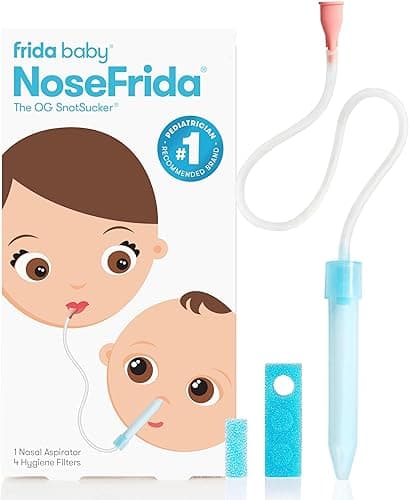
Frida Baby NoseFrida The Snotsucker Baby Nasal Aspirator
Look, we know sucking snot sounds like a horror movie plot, but the NoseFrida is the GOAT of nursery essentials. It’s weirdly satisfying, incredibly effective, and way more hygienic than those old-school bulbs that grow mold in secret.
The Biological Necessity: Why Clear Airways Matter
To understand why a tool like the NoseFrida is essential, we must first understand infant anatomy. Newborns and young infants are what medical professionals call "obligate nasal breathers." This means that for the first several months of life, babies primarily breathe through their noses rather than their mouths.
When a baby’s nasal passages become clogged with mucus—whether due to a common cold, allergies, or simply dry air—it isn’t just an inconvenience; it is a significant disruption to their basic biological functions.
The Impact on Feeding and Sleep
Infants rely on a complex "suck-swallow-breathe" rhythm during feeding. If their nose is blocked, they cannot breathe while they eat. This leads to frustrated, hungry babies who pull off the breast or bottle frequently to gasp for air, leading to increased air intake, gas, and fussiness.
Furthermore, because infants cannot yet mouth-breathe effectively during sleep, congestion leads to fragmented rest. A baby who can’t breathe through their nose will wake up every time they start to drift off, leading to an exhausted child and even more exhausted parents. Clearing the airway isn't just about comfort; it is about protecting the child’s ability to nourish themselves and recover through sleep.
Preventing Secondary Infections
Stagnant mucus in the nasal cavity is a breeding ground for bacteria. When congestion is left unaddressed, it can migrate into the Eustachian tubes, leading to painful middle ear infections (Otis media). In some cases, upper respiratory congestion can descend into the chest, contributing to bronchiolitis or pneumonia. By effectively removing mucus with a high-quality aspirator, you are actively reducing the risk of these secondary complications.
Why the NoseFrida Outperforms the Traditional Bulb
For decades, the blue rubber bulb syringe was the gold standard in hospitals. However, the bulb syringe has several significant flaws that the NoseFrida (and similar oral suction aspirators) was designed to solve.
Sustained Suction vs. Short Bursts
A bulb syringe relies on a single squeeze-and-release motion. This creates a quick, sharp burst of suction that often fails to move thick or deep-seated mucus. The NoseFrida, however, uses your own lung capacity. Because you are the "motor," you can provide long, sustained, and controlled suction. This allows you to draw out stubborn mucus from deep within the nasal passage that a bulb simply cannot reach.
Safety and Mucosal Integrity
One of the dangers of traditional bulb syringes is that they are designed to be inserted into the nostril. If a baby moves suddenly, the hard tip can poke the delicate mucosal lining, causing swelling or nosebleeds. The NoseFrida is designed with a flared tip that sits against the nostril, creating a vacuum seal without ever entering the sensitive internal structures of the nose. This "seal-not-insert" design makes it significantly safer for wiggly infants.
The Transparency Factor
Perhaps the most overlooked benefit of the NoseFrida is that it is transparent. With a rubber bulb, you have no idea what you’ve actually removed—or if you’ve removed anything at all. With the NoseFrida, you get immediate visual feedback. You can see the color and consistency of the mucus, which can be helpful information to share with your pediatrician if the illness persists.
Addressing the "Ick" Factor: How the Filter Works
The number one question every parent asks is: "Am I going to get snot in my mouth?"
The answer is a definitive no. The NoseFrida utilizes a disposable, medical-grade foam filter. This filter is clinically proven to prevent the transfer of mucus and bacterial germs from the child to the user. When you inhale, you are moving air through the tube, but the physical moisture and biological matter are trapped entirely by the blue sponge.
Hygiene and Maintenance
Unlike the old-fashioned bulbs, which are notorious for growing black mold on the inside because they cannot be opened or dried properly, the NoseFrida is fully clinical. It can be disassembled, washed with hot soapy water, and air-dried. It is essential to choose high-quality products like this because medical-grade plastics are less likely to harbor bacteria and are more durable over the long term.
The Expert Technique: A Step-by-Step Guide
Using the NoseFrida is an art form. If you simply stick it to a dry nose and suck, you will likely be disappointed. To get the "motherload" of mucus, follow this clinical protocol:
- Hydrate and Loosen: Use a saline spray or drops first. This is non-negotiable. Saline breaks up the molecular bonds of thick mucus. Place two drops in each nostril and wait about 60 seconds.
- The Swaddle: If your baby is a "fighter," use a swaddle or a "burrito wrap" to keep their hands down. This prevents them from knocking the tube away and ensures a steady application.
- The Seal: Place the large tube against the nostril, ensuring you’ve created a complete seal. You shouldn't hear any air escaping around the edges.
- The Suction: Use the red mouthpiece to suck. Start with a gentle, steady pull. If the mucus is stubborn, use a "pulsing" rhythm to encourage it to move.
- The Clean-Up: Discard the filter after each session and wash the blue tube with warm water.
Expert Tip: The Angle Matters
Don't aim the tube straight up toward the forehead. Aim it slightly back and toward the ear on the same side. This follows the natural anatomy of the nasal floor and is where the majority of congestion tends to pool.
Parent-to-Parent: Managing the Drama
Let’s be honest: your baby will probably hate this. They will scream, they will turn red, and they will look at you like you are betraying their trust.
As a parent, this can be heart-wrenching. However, it’s important to reframe the situation. The crying actually helps. When a baby cries, their nasal passages open up, and they often "snort" more mucus forward, making it easier for you to catch.
The most important thing to remember is the immediate relief. Almost the second you stop, the baby will realize they can breathe again. Many parents report that their child goes from a screaming fit to a peaceful sleep or a focused feeding within minutes of a NoseFrida session.
When to Call the Doctor
While the NoseFrida is a powerful home remedy, it is not a substitute for medical professional intervention. You should contact your pediatrician if you notice any of the following:
- Retractions: If you see the skin pulling in around your baby’s ribs or the base of their throat when they breathe, this is a sign of respiratory distress.
- Fever: Any fever in an infant under 3 months is an automatic call to the doctor.
- Dehydration: If the congestion is so bad the baby isn't taking in enough fluid (fewer than 6 wet diapers in 24 hours).
- Duration: If the mucus is thick and green/yellow for more than 10-14 days.
- Lethargy: If the baby is unusually difficult to wake or seems limp.
Final Verdict: An Essential for the Modern Nursery
In the world of parenting products, there are many "nice-to-haves" and very few "must-haves." The NoseFrida firmly falls into the latter category. It is an inexpensive, low-tech, high-impact tool that empowers parents to provide immediate, tangible relief to their suffering children.
Yes, the concept is a little gross. Yes, you will find yourself discussing snot consistency with your partner more than you ever thought possible. But when it’s 3:00 AM and your newborn is struggling to breathe through a stuffy nose, you won't care about the "ick factor." You’ll be reaching for the blue tube, and you’ll be glad you have it. Investing in high-quality, doctor-recommended health tools is the first step toward confident, effective caregiving.