Grimm's Rainbow: Is It Just for Instagram?
Beyond the vibrant colors and the perfectly curated shelves of social media influencers lies a foundational tool for childhood development: the Grimm’s Rainbow. While it is undeniably "Instagrammable," its true value exists in the hands of a child, not the lens of a camera. As pediatric specialists and developmental advocates, we view this iconic wooden toy not as a luxury decor item, but as an essential catalyst for "open-ended play."
In this guide, we will dive deep into the science of why this specific toy has become a staple in Montessori and Waldorf-inspired homes, and why the quality of the materials matters more than you might think.
Beyond the Aesthetic: The Developmental Power of Open-Ended Play
In a world filled with "closed-ended" toys—those that light up, make noise, and have a singular way to be played with—the Grimm’s Rainbow is a breath of fresh air. From a pediatric perspective, closed-ended toys often place the child in a passive role; the toy performs, and the child watches. Open-ended play, conversely, requires the child to be the architect of their own experience.
When a child looks at a set of wooden arches, they aren't just looking at a rainbow. Through the lens of creative cognition, they are seeing a tunnel for their wooden cars, a cradle for a doll, a fence for farm animals, or even a giant’s telephone. This mental flexibility is the precursor to complex problem-solving skills in later life.
The Science of "Loose Parts"
The Grimm’s Rainbow falls under the category of "Loose Parts" play—a term coined by architect Simon Nicholson. The theory suggests that materials that can be moved, carried, combined, redesigned, lined up, and taken apart and put back together again provide significantly more opportunities for creative engagement than static toys.
By manipulating these arches, children develop divergent thinking, which is the ability to generate creative ideas by exploring many possible solutions.
The Tactile Advantage: Why Wood Trumps Plastic
The original text mentions the "slightly rough" texture of the Grimm’s arches, and from a developmental standpoint, this is a critical feature. Most mass-produced plastic toys are incredibly smooth. While this makes them easy to clean, it offers very little sensory feedback and makes stacking a frustrating exercise for developing motor skills.
Friction and Fine Motor Control
The arches of a genuine Grimm’s Rainbow are hand-carved from FSC-certified lime wood (linden). The wood is stained with a non-toxic, water-based color rather than being sealed with a thick, glossy lacquer. This preserves the natural "tooth" of the wood.
Why this matters:
- Gravity-Defying Stacks: The friction between the stained wooden surfaces allows children to stack the arches in ways that would be impossible with plastic. This success builds confidence and encourages the child to experiment with more complex architectural structures.
- Proprioceptive Input: Wood has a specific weight and "give." When a child handles these pieces, their brain receives clear feedback about how much pressure is needed to hold, lift, or balance an object. This is essential for developing hand-eye coordination and fine motor precision.
Expert Tip: The Safety of Non-Toxic Stains
As pediatricians, we often see "mouthers"—children who explore their world through taste. When selecting high-quality products like the Grimm’s Rainbow, the water-based, non-toxic stain is a non-negotiable safety feature. Unlike cheap painted toys that can flake or chip, the stain penetrates the wood fibers. This ensures that even if a toddler gnaws on an arch, they are not ingesting lead, phthalates, or harmful pigments.
Developmental Milestones: How the Rainbow Grows with Your Child
One of the most frequent questions parents ask is, "When is the right time to buy this?" The answer is that its utility spans several years of distinct developmental milestones.
The Infant Stage (6–12 Months): Sensory Exploration
At this stage, the rainbow is a sensory object. The infant will practice their palmar grasp (using the whole hand) to pick up smaller arches. They are learning about "object permanence" and the physical properties of weight and color.
The Toddler Stage (1–3 Years): The Builder
As the pincer grasp develops, toddlers begin to experiment with stacking. This is also the "schema" stage. You might notice your child going through a "transporting schema" (carrying the arches from one room to another) or an "enveloping schema" (placing other toys inside the arches).
The Preschool Stage (3–5 Years): Imaginative Worlds
This is where the rainbow truly shines. The arches become bridges for complex train tracks or mountains for small-world play. The child is now using symbolic representation, where one object stands in for another—a hallmark of cognitive maturity.
The School-Age Stage (5+ Years): Physics and Art
Even older children find value in the rainbow by challenging themselves with balance. They may try to create 3D sculptures or use the pieces to learn about fractions and proportions. It transitions from a "toy" to a tool for artistic expression.
Engineering 101: Building Spatial Awareness and Physics Skills
Every time a child stacks an arch, they are performing a subconscious physics experiment. They are learning about:
- Center of Gravity: If the arch is placed too far to the left, the structure collapses.
- Structural Integrity: Which arches can support the weight of others?
- Symmetry: Balancing the visual weight of the colors and sizes.
When we provide high-quality materials that behave predictably, we foster a child’s inner scientist. A high-quality wooden set won't warp or bend, meaning the lessons the child learns about balance one day will still be true the next.
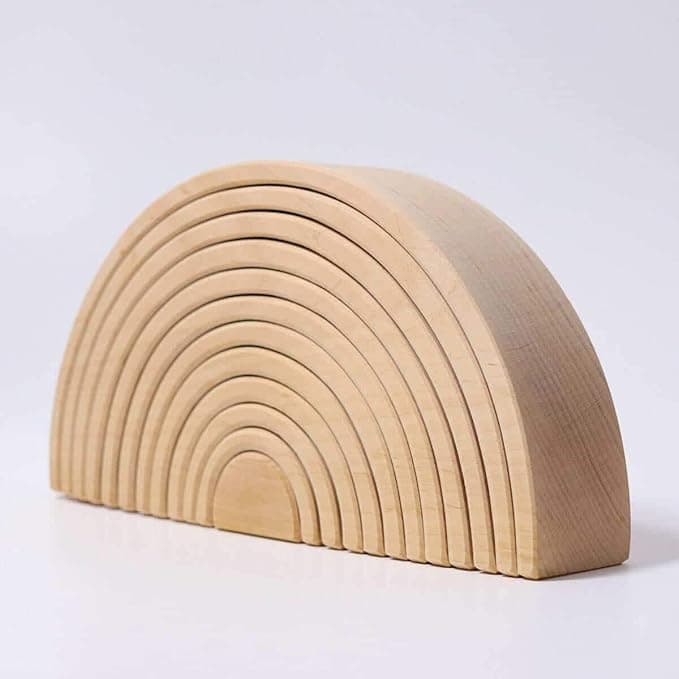
The GooGaia Standard: Why Craftsmanship Matters
In a marketplace flooded with "dupes" and cheaper alternatives, it is important to understand why investment-grade toys are worth the premium. High-quality products are built to last generations, reducing environmental waste and providing a consistent play experience.
The Grimm’s Rainbow is made from FSC Certified Lime Wood. This isn't just a marketing buzzword; it means the wood is sourced from forests that provide environmental, social, and economic benefits. Furthermore, the lime wood is lightweight but structurally strong, ensuring that even the largest arch is manageable for a small child but won't snap under pressure.
Parent-to-Parent Tip: Think of this as an "heirloom" purchase. Unlike plastic toys that often end up in landfills once a child outgrows them, a genuine Grimm's Rainbow retains nearly 70-80% of its resale value, or better yet, stays in the family for your future grandchildren.
Practical Play: Parent-to-Parent Ideas for Every Age
If you’ve brought your rainbow home and your child seems unsure where to start, try these "invitations to play":
- The Color Match: Lay out the arches and gather household objects (a red ball, a blue sock, a yellow lemon). Encourage your toddler to "find the home" for each item by matching colors.
- The Marble Run: Use the arches to create a sloped path. This is a fantastic way to teach about velocity and motion.
- The Animal Parade: Use the arches as "stalls" or "caves" for animal figurines.
- The Balance Challenge: For older kids, see how many arches they can stack vertically before they topple.
Expert Tip: When Play Becomes Frustrating
If your child becomes frustrated because their tower keeps falling, resist the urge to build it for them. Instead, use "scaffolding" language. Say, "I see that the blue arch is wobbling. I wonder if it needs to be moved closer to the center?" This empowers the child to solve the problem themselves.
Expert Perspective: The Role of Minimalism in Pediatric Cognitive Health
From a pediatric standpoint, we are seeing a rise in "overstimulated" environments. Rooms filled with bright, flashing, noisy toys can lead to shorter attention spans and higher levels of cortisol (the stress hormone) in children.
The Grimm’s Rainbow supports a "slow-play" movement. Its natural wood grain and muted (yet vibrant) tones provide visual stimulation without the sensory "noise." This allows the child to enter a state of Flow—a psychological state of deep immersion in an activity. Flow is essential for developing focus, patience, and long-term cognitive endurance.
Verdict: Is It Worth It?
While the price tag can be a point of hesitation, the Grimm's Rainbow earns its keep through its multi-generational longevity and its unparalleled developmental benefits. It is more than just an "Instagram prop"; it is a sophisticated tool for learning that honors the child’s natural curiosity.
By investing in high-quality, sustainably made toys, you are providing your child with a safe, tactile, and endlessly creative foundation for their most important job: Play.