Blackout Curtains in a Bag: The SlumberPod
Traveling with a baby or toddler is often described as "parenting in a different location," but for many families, it feels more like a tactical mission where the primary objective is avoiding a total sleep meltdown. One of the most significant hurdles to successful travel sleep is the "darkness dilemma." In a standard hotel room or a shared Airbnb space, parents often find themselves sitting in pitch-black silence from 7:00 PM onwards, whispering in the dark to avoid waking a baby whose internal clock is finely tuned to light exposure.
This is where the SlumberPod—essentially "blackout curtains in a bag"—changes the narrative. It is a portable, bottomless privacy canopy that fits over most standard playards, travel cribs, and even some toddler cots. But beyond the convenience, there is a profound scientific and developmental reason why this specific type of sleep environment is so effective.
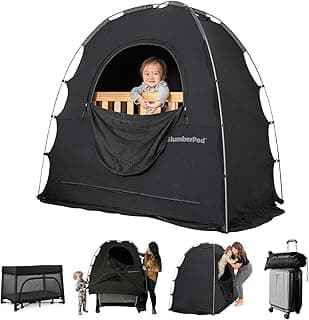
SlumberPod 3.0 Portable Blackout Privacy Pod
The SlumberPod is a genius travel accessory that creates a pitch-black sleep environment over any standard pack-n-play or mini crib. When you're staying in hotels, at grandparents', or camping, it recreates the exact dark nursery environment your baby is used to — often saving the entire vacation.
The Science of Sleep: Why Darkness Matters for Development
To understand why a tool like the SlumberPod is essential, we must look at the biological mechanisms of infant sleep. Sleep isn't just a period of inactivity; it is a critical window for neurodevelopment, memory consolidation, and physical growth.
The Role of Melatonin and the Circadian Rhythm
The human body operates on a circadian rhythm—an internal 24-hour clock regulated by the suprachiasmatic nucleus (SCN) in the brain. This clock is highly sensitive to light. When the eyes detect light, the brain suppresses the production of melatonin, the hormone responsible for signaling to the body that it is time to rest.
For infants and toddlers, whose sleep cycles are still maturing, even a small amount of light—the glow from a hotel television, a sliver of sun peaking through "blackout" curtains, or the hallway light under a door—can be enough to trigger wakefulness. By providing a truly pitch-black environment, the SlumberPod ensures that the child’s melatonin production remains uninterrupted, facilitating deeper, more restorative sleep cycles.
Sensory Regulation and Overstimulation
Travel involves a barrage of new sensory inputs: different smells, unfamiliar noises, and new visual surroundings. For many children, this leads to overstimulation. A privacy tent acts as a sensory "reset" button. By removing the visual distractions of a new room (and the distracting sight of their parents sitting just a few feet away), the SlumberPod helps a child's nervous system downregulate, making the transition to sleep much faster.
Why We Chose It: Solving the Number One Travel Sleep Problem
We chose to highlight the SlumberPod because it addresses the logistical nightmare of "room sharing" during travel. In a typical home environment, most children sleep in their own nurseries. During travel, the family is often condensed into a single room.
The "I See You" Phenomenon
Once a baby hits the 6-to-9-month mark, they develop object permanence. If they wake up briefly between sleep cycles and see you across the room, they are highly unlikely to self-soothe back to sleep. They want to interact. The SlumberPod creates a physical and visual barrier that maintains the "solitary" sleep environment they are used to at home, even if you are only three feet away eating takeout in the hotel bed.
Portability and Consistency
High-quality sleep products for travel must be two things: effective and portable. The SlumberPod collapses into a small carry-on-friendly bag and weighs very little. More importantly, it provides a "consistent" environment. Whether you are at Grandma’s house, a luxury hotel, or a tent in the woods, the interior of the SlumberPod looks and feels exactly the same to your child. This consistency is a powerful psychological cue that tells the child they are safe and it is time to sleep.
Pediatric Safety and Breathability
When discussing any product that encloses a sleeping child, safety is the primary concern. As pediatric specialists, we emphasize that "blackout" should never come at the cost of "breathable."
The SlumberPod is engineered with a unique fabric blend that allows for airflow while blocking 90% or more of light. It has been rigorously tested for CO2 rebreathing and air exchange. Furthermore, it features specialized pockets designed to hold a baby monitor (so you can keep a visual eye on your child) and dedicated fan pockets to ensure optimal temperature regulation.
Expert Tip: Maintaining the Optimal Sleep Temperature
The American Academy of Pediatrics (AAP) recommends keeping sleep environments between 68 and 72 degrees Fahrenheit. Because the SlumberPod is an enclosed space, it can trap a small amount of body heat. We always recommend using the compatible SlumberPod fan and dressing your child in one less layer than you normally would to ensure they remain at a safe, comfortable temperature.
Practical "Parent-to-Parent" Tips for Success
Even the best products require a strategy for implementation. Here is how to ensure your first night with the SlumberPod isn't a struggle:
- The "Home Run" Strategy: Do not let the first time your child sees the SlumberPod be at 8 PM in a strange hotel. Set it up in your living room or nursery a week before your trip. Let them crawl in and out of it during playtime. Have them take one or two naps inside it at home so the environment becomes familiar and "safe."
- The Monitor Setup: Use the designated monitor pouch. Seeing your child's chest rise and fall via the monitor provides immense peace of mind, especially when using a blackout tent for the first time.
- Mind the "Bottomless" Design: Remember that the SlumberPod does not have a floor. It fits over the playard. Ensure your travel crib is fully assembled and the mattress is flat and secure before lowering the Pod over it.
- Ventilation is Key: Always open the ventilation flaps if the room feels warm. Use a battery-operated fan in the designated pocket to keep air circulating.
When to Call the Doctor: Sleep and Travel Concerns
While travel usually disrupts sleep temporarily, there are times when sleep issues may signal a larger concern. Consult your pediatrician if:
- Extreme Lethargy: Your child is unusually difficult to wake after a long travel day.
- Excessive Night Sweating: If your child is soaking through their pajamas despite a cool room and the use of a fan, they may be struggling with temperature regulation.
- Prolonged Regression: It is normal for sleep to be "off" for 3-5 days after returning from a trip. If your child’s sleep remains completely disrupted for more than two weeks, there may be an underlying issue like an ear infection or separation anxiety that needs professional attention.
Comparison: Why This vs. DIY Solutions?
Many parents try to DIY a blackout environment using trash bags on windows or draped blankets over cribs. As experts, we strongly discourage "blanket draping." Loose blankets over a crib pose a significant strangulation and suffocation risk, and they rarely stay in place.
Trash bags on windows can work, but they are tedious to install and often fall down in the middle of the night. The SlumberPod provides a structural, tested, and reliable solution that is far safer and more effective than any improvised hack. When it comes to your child's safety and your own sanity (and sleep), investing in a high-quality, purpose-built product is always the superior choice.
The Verdict
It looks a bit like a camping tent has sprouted in the middle of your hotel room. It looks, as we've said, slightly ridiculous. But from a pediatric and developmental perspective, the results are undeniable.
The SlumberPod solves the most common travel sleep issues by honoring the child's biological need for darkness and the parents' need for a functional evening. By maintaining the integrity of the circadian rhythm and providing a consistent, safe sensory environment, it ensures that your vacation actually feels like a vacation—not an exercise in sleep deprivation. Do not travel without it. It is, quite simply, the gold standard for portable sleep hygiene.